Projects

Our projects use large language models, AI characters, and virtual human interventions to communicate health information. Each is developed and evaluated with the people it is meant to serve — patients, caregivers, clinicians, community health workers, and students.

Complex medical reasoning has generally required frontier language models, which puts it out of reach for resource-constrained clinical settings. TeamMedAgents is a modular multi-agent framework that translates evidence-based teamwork principles from organizational psychology — Salas and colleagues’ “Big Five” model — into independently configurable computational mechanisms: shared mental models, team leadership, team orientation, trust networks, and mutual monitoring. The architecture dynamically recruits two to four specialist agents and runs a structured four-phase deliberation with adaptive component selection. Across eight medical benchmarks covering 11,545 questions, the framework reaches 77.63% overall accuracy. Ablation studies show that teamwork components are task-specific rather than universally beneficial: shared mental models help most on knowledge tasks, trust mechanisms improve differential diagnosis, and enabling every component at once degrades performance. Ongoing work extends the approach from agent-agent to mixed human-agent teams, testing collaboration theories including joint intention, shared mental models, and team situation awareness. Planned outputs include an open-source codebase of theory-grounded agent architectures, a simulation testbed for healthcare collaboration tasks, and annotated interaction datasets.

Mishra, P. P., Arvan, M., & Zalake, M. TeamMedAgents: Enhancing Medical Decision-Making of LLMs Through Structured Teamwork. arXiv:2508.08115. Supported by the Gemma 3 Academic Program, Google.

Community health workers at Latino community organizations provide culturally relevant dementia support, but they often field complex questions with limited reference materials and no fast way to locate the right information mid-conversation. Existing resources — print guides, in-person training, static digital tools — lack natural language interactivity and cannot adapt to the specific caregiving situation in front of the worker. AZChat is a multilingual, LLM-powered chatbot built with retrieval-augmented generation so that responses stay grounded in sources curated by community health workers and content experts, with citations linked back for verification. It is being developed through eight co-design sessions with both experienced and novice community health workers, examining how to design the tool and how workers’ expectations of collaborating with AI change over the course of iterative development. With David Marquez (Kinesiology and Nutrition, UIC), Nikita Soni (Computer Science, UIC), and Perla Castro (LA CARE).

Supported by the CHECA Scientist Program, UIC Center for Health in Cognitive Aging.

Black adults face higher colon cancer morbidity and mortality, yet make up only 6.6% of participants in colon cancer clinical trials compared with 77% for White patients. Traditional recruitment — advertisements, or electronic health record screening inside a single hospital — is slow and geographically constrained, and current social media recruitment relies on broad, untargeted advertising.

This project asks whether large language models can identify potential trial participants from what people already share publicly about their health. We built TRIALQA, a dataset drawn from colon cancer and prostate cancer subreddits and annotated against eligibility criteria from real registered trials for two things: whether a user meets a given criterion, and the reasons they give for being interested in taking part. We then benchmarked seven widely used LLMs across six training and inference strategies.

The result is a caution as much as a promise. LLMs read the surface of a post well, but struggle with the multi-hop reasoning that eligibility criteria actually demand. A RoBERTa natural language inference baseline stayed competitive with most of the models tested, and smaller models were not reliably worse — Mistral-7B with self-consistency matched or beat considerably larger ones. Follow-on work explores graph-augmented approaches to the same task.

Alongside identification, we are developing LLM-powered virtual agents that provide trial education and address well-documented distrust in research. Because machine learning models can discriminate against minority and disadvantaged groups, the algorithmic work is evaluated for fairness and interpretability using demographic parity and equalized odds, with chain-of-thought reasoning to make decisions inspectable. Privacy-preserving practices reach people collectively through the pages and communities they engage with, rather than targeting individuals directly.

Zhou, X., Wang, Z., Krieger, J., Zalake, M., & Cheng, L. Smart Trial: Evaluating the Use of Large Language Models for Recruiting Clinical Trial Participants via Social Media. arXiv:2509.10584

Zhou, X., Wang, Z., Krieger, J., Zalake, M., & Cheng, L. Graph-Augmented LLMs for Social-Media-based Clinical Trial Recruitment. SSRN 6256514

With Zisu Wang (Colorado State University), Lu Cheng (Computer Science, UIC), and Janice Krieger (Mayo Clinic Comprehensive Cancer Center Florida).

Supported by a pilot grant from the UIC Institute for Equitable Health Data Science Research.

A digital twin of a doctor (DTD) is an AI-generated character that shares the facial and vocal identity of a real doctor and can deliver health information to patients. A familiar face could make health information more credible and more personal — but it also puts a doctor’s likeness behind words they did not say.

We interviewed 13 physicians and residents at University of Illinois Health, across specialties ranging from family medicine to neurosurgery, about using digital twins of themselves. They saw clear value in offloading repetitive communication: pre- and post-operative instructions, interpretation of test results, and the additional detail there is rarely time for in a short visit. Several described a personalized video as something that would make patients feel more attended to, not less.

The concerns centered on identity. Eight of the thirteen worried about their own face being used to deliver inaccurate information, against four who felt their identity would mainly enhance credibility, and seven proposed using a randomly generated face instead of their own. Doctors also raised the question of who is liable when a twin gets something wrong, and cautioned that emotionally sensitive news should never be delivered this way. Even so, eleven said they would be willing to create their own digital twin if content accuracy and patient reception were addressed.

Current work turns to the other stakeholder: how patients perceive and respond to a digital twin of their own doctor, and how that shapes trust, engagement, comprehension, and adherence. The study is deliberately bounded. Conversations are educational only, with no diagnosis and no medical advice; doctors consent to the use of their likeness and voice for this research alone; and patients are told before they begin that they are speaking with generative AI rather than with their doctor.

Zalake, M. (2023). Doctors’ perceptions of using their digital twins in patient care. Scientific Reports, 13(1), 21693. https://doi.org/10.1038/s41598-023-48747-5

Supported by the Accelerating Foundation Models Research initiative, Microsoft.

Latinos have the highest proportion of older adults with Alzheimer’s disease and related dementias (ADRD) in the United States and tend to develop it earlier, yet Latino caregivers report significant gaps in knowledge about the disease. Existing education approaches each hit a limit: written materials exclude people with lower literacy, face-to-face promotora programs are labor-intensive and hard to scale, and stigma leads many caregivers to avoid discussing ADRD outside the family at all. AI-PROMOTORA delivers ADRD education through a web-based Latino AI character that holds the conversation verbally and privately at home. Content is adapted from the Savvy Caregiver Program and developed with a community advisory board convened with LA CARE, then assessed through focus groups with Latino caregivers of relatives at high risk of dementia. With David Marquez (Kinesiology and Nutrition, UIC), Crystal Glover (Behavioral Sciences, RUSH), and Perla Castro (LA CARE).

Supported by the Research Project Pilot Grant Program, Chicago Chronic Condition Equity Network (C3EN, 5P50MD017349).

First-year attrition is a persistent problem in higher education, and colleges cannot scale one-to-one mentorship simply by adding staff. AI-MENTOR explores whether AI replicas of real mentors — academic advisors and instructors, rendered with their own faces and voices — can supplement existing student support by improving academic motivation, a factor institutional analysis links to retention. A preliminary study found that students rated an AI replica of a real instructor as more competent, skillful, trustworthy, and satisfying than a generic 3D virtual character, suggesting that mentor identity matters for credibility. The project focuses on first-year seminar courses (AHS 100 and KN 100), which UIC’s retention analysis identifies as a significant predictor of retention, GPA, and credits earned. Over 18 months, the mentor is being designed with students rather than for them, through a participatory design study in which first-year students spanning a range of incoming GPAs join the design team for contextual inquiry, idea generation, and prototype refinement. In collaboration with the AHS Office of Student Affairs.

Supported by a pilot grant from the UIC College of Applied Health Sciences.

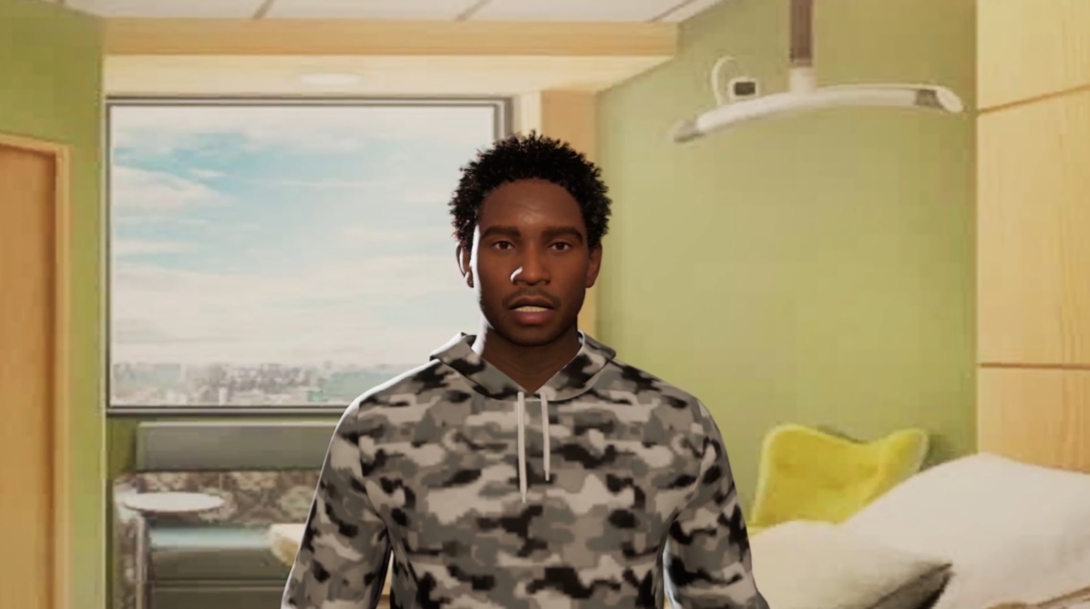
Racial bias among providers is linked to differential communication and treatment decisions, contributing to an estimated $93 billion in excess medical costs per year. Bias trainings are widespread, but most rely on passive, case-based instruction and shift knowledge and attitudes rather than behavior. EQUITY is a virtual patient system that places medical providers in a simulated clinical encounter where racial bias arises, then supports deliberative reflection on what happened. Its central commitment is that the scenarios come from patients. Most virtual patient design draws only on provider perspectives, which risks reproducing the stereotypes it is meant to address. We developed the scenario from focus groups with Black patients describing their own experiences of provider bias, then assessed how interacting with the virtual patient influences providers’ self-reflection. With Monique Jindal (Medicine, UIC) and Eric Swirsky (Biomedical and Health Information Sciences, UIC).

Supported by an AHS Interdisciplinary Pilot Grant.

Zalake, M., Swirsky, E., Chisunkha, B., & Jindal, M. “My doctor didn’t give me half of that privilege”: Incorporating Black Patients’ Lived Experiences in Virtual Patients for Racial Bias Mitigation Training. ACM Conference on Human Factors in Computing Systems (CHI), 2025, Article 346. https://doi.org/10.1145/3706598.3713549

Brain donation rates among Latinos need to increase for research on Alzheimer’s disease and related dementias to reflect the population it serves. Donation decisions rarely rest with the potential donor alone, since family approval matters, so an intervention has to reach both. B-DONATE is a scalable web-based virtual human intervention that engages potential donors and their family members verbally in Spanish, making the conversation accessible to families who would otherwise never encounter it.

With David Marquez (Kinesiology and Nutrition, UIC) and Crystal Glover (Behavioral Sciences, RUSH).

Supported by the Rush Alzheimer’s Disease Research Center and the National Institute on Aging (5P30AG072975-03).

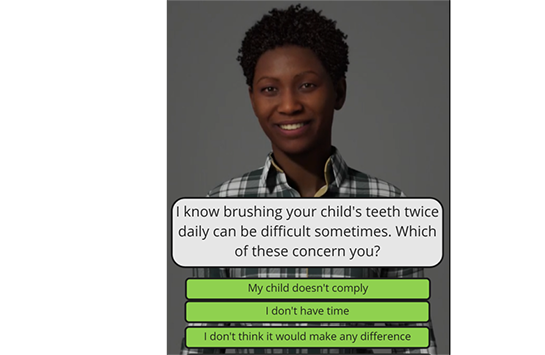
Early childhood caries is the most common chronic disease in children, affecting roughly 4.5 million each year, and is largely preventable by twice-daily brushing with fluoride toothpaste from an early age. Most oral health interventions target caregiver knowledge, but knowledge is rarely the barrier — most caregivers already know that brushing matters. What they face is child noncompliance, routine-setting, and time. Interventions that address those barriers well are one-to-one and labor-intensive, while scalable digital alternatives tend to lose engagement. IVORY is a web-based virtual human intervention delivered at home that combines oral health education with parenting strategies for child cooperation and self-efficacy skills training. It was developed iteratively through focus groups with caregivers of children aged three to six. With Amy Slep (New York University), Nikita Soni (Computer Science, UIC), Sobia Bilal and David Avenetti (College of Dentistry, UIC).

Supported by a pilot grant from the UIC Center for Clinical and Translational Science (UL1TR002003).